Your plant isn't air-gapped anymore. Stop securing it like it is.

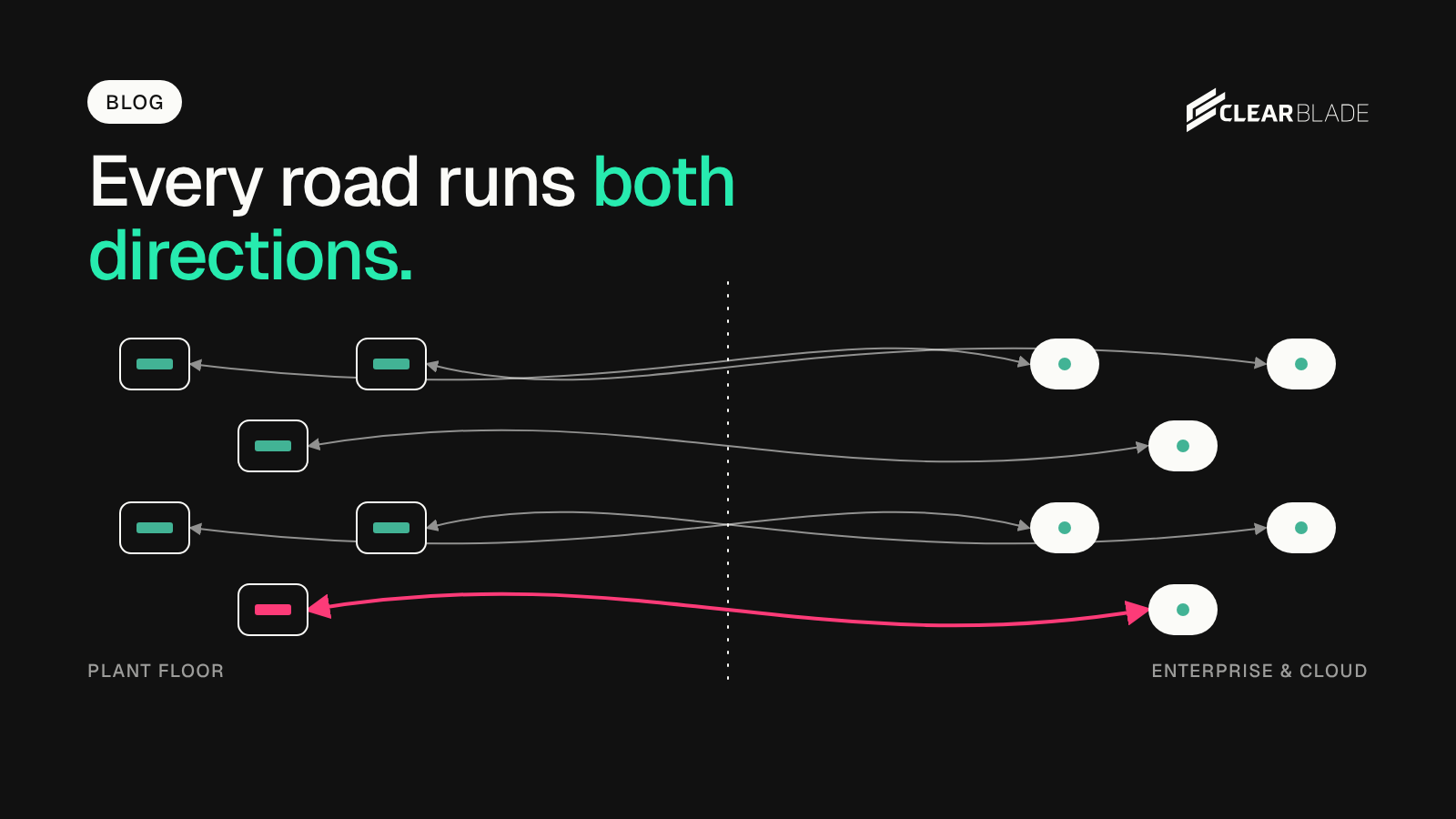
I still hear it in boardrooms: "Our OT network is separate." It isn't. It hasn't been for years.
Every remote monitoring dashboard, every predictive maintenance pilot, every ERP integration and cloud analytics project you approved built a road between the plant floor and the enterprise. Every one of those roads runs both directions. The attacker who used to stop at your firewall now has a route to a PLC. And industrial operators make attractive targets for one simple reason: downtime is expensive, so they pay.
I'm not arguing against IT/OT convergence. A connected plant is a more valuable plant. I'm arguing against how most companies did it.
The default was a mistake
For the last decade, the default architecture came from hyperscaler IoT stacks and cloud-first platforms. Connect every device, ship every raw tag to the cloud, figure out the value later. It's a great model for selling compute and storage. It's a terrible model for security.
Every device reaching upstream is another connection to defend. Every raw data stream in the cloud is more operational data outside your walls. Every system that touches it lands inside your audit boundary. Then the answer to all that exposure is more monitoring, more consoles, and more security people you can't hire. Adding tools to watch a problem you created is not a plan.
Decide at the edge
This is why we started ClearBlade. Not for latency. Not for bandwidth. Because the decision should happen next to the asset.
When filtering, rules and inference run at the edge, only results cross the boundary. One outbound path carrying decisions instead of hundreds of devices talking to your enterprise network. Legacy controllers and protocols terminate locally, so a 20-year-old PLC never becomes an internet-facing asset. And when the link drops, the site keeps running.
That last point matters more than most execs realize. We work with rail operators where losing connectivity is a normal day, not an incident. Because the logic lives on site, cutting the link is a containment move, not an outage. Operations continue. Data syncs when it's safe.
The safest connection is the one you never made. Every data flow you don't need is attack surface you don't have to staff.
Four questions to ask your team on Monday
- What operational data leaves our plants today, and who actually uses it? If nobody can answer on one page, that's your finding.
- If a site lost its connection for four hours, what stops? Anything that stops is a dependency we never meant to buy.
- How many vendors sit between our equipment and the cloud, and which of them can show a current third-party audit?
- Which of those data flows could be replaced by a decision made on site?
Hold your vendors to the same standard, including us. ClearBlade runs 60M+ devices across 38 countries at 99.9% uptime, and we're SOC 2 Type 2 audited and ISO/IEC 27001:2022 certified. Ask everyone in your data path for that evidence, in writing.
Connected doesn't have to mean centralized
It's Cybersecurity Awareness Month. You don't need a new framework to mark it. You need a map of what leaves your plants and a short list of what no longer has to.
If you want a straight answer on what you can stop sending, message me. Bring your architecture. I'll tell you what I'd cut.

ClearBlade Monthly Newsletter
News, trends, and true stories of IoT, Edge AI and connected Digital Twins in action.

Related Blogs.